Menu bar clipboard, minus the cloud.

The Mac clipboard bar
with local OCR.

MacBar captures text, screenshots, copied image files, and Finder files, extracts OCR on-device, and gets you back to paste in one clean loop.

Hotkey ⇧⌘M
Searches Text + OCR + files
Runs on macOS 14+, Apple Silicon
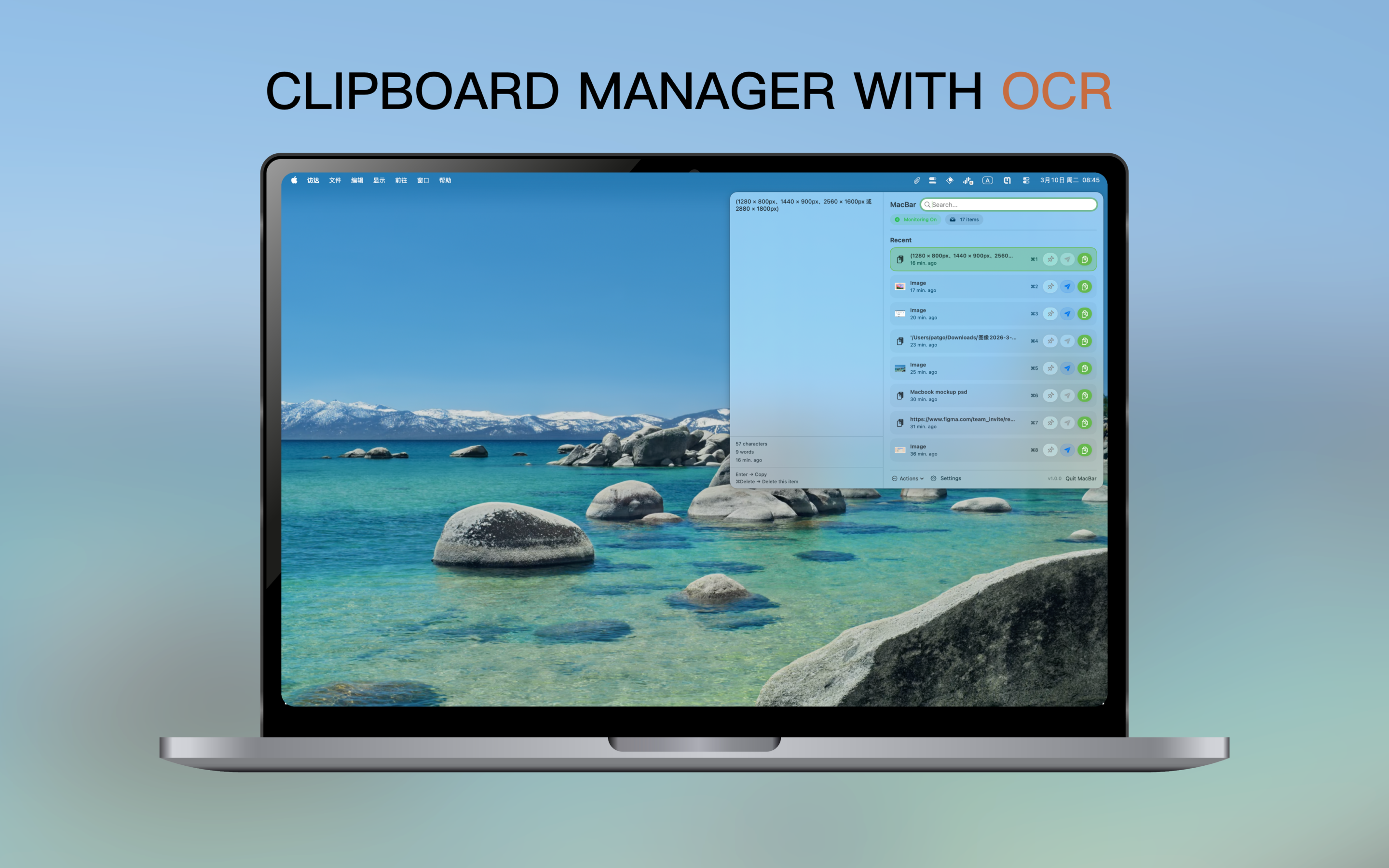
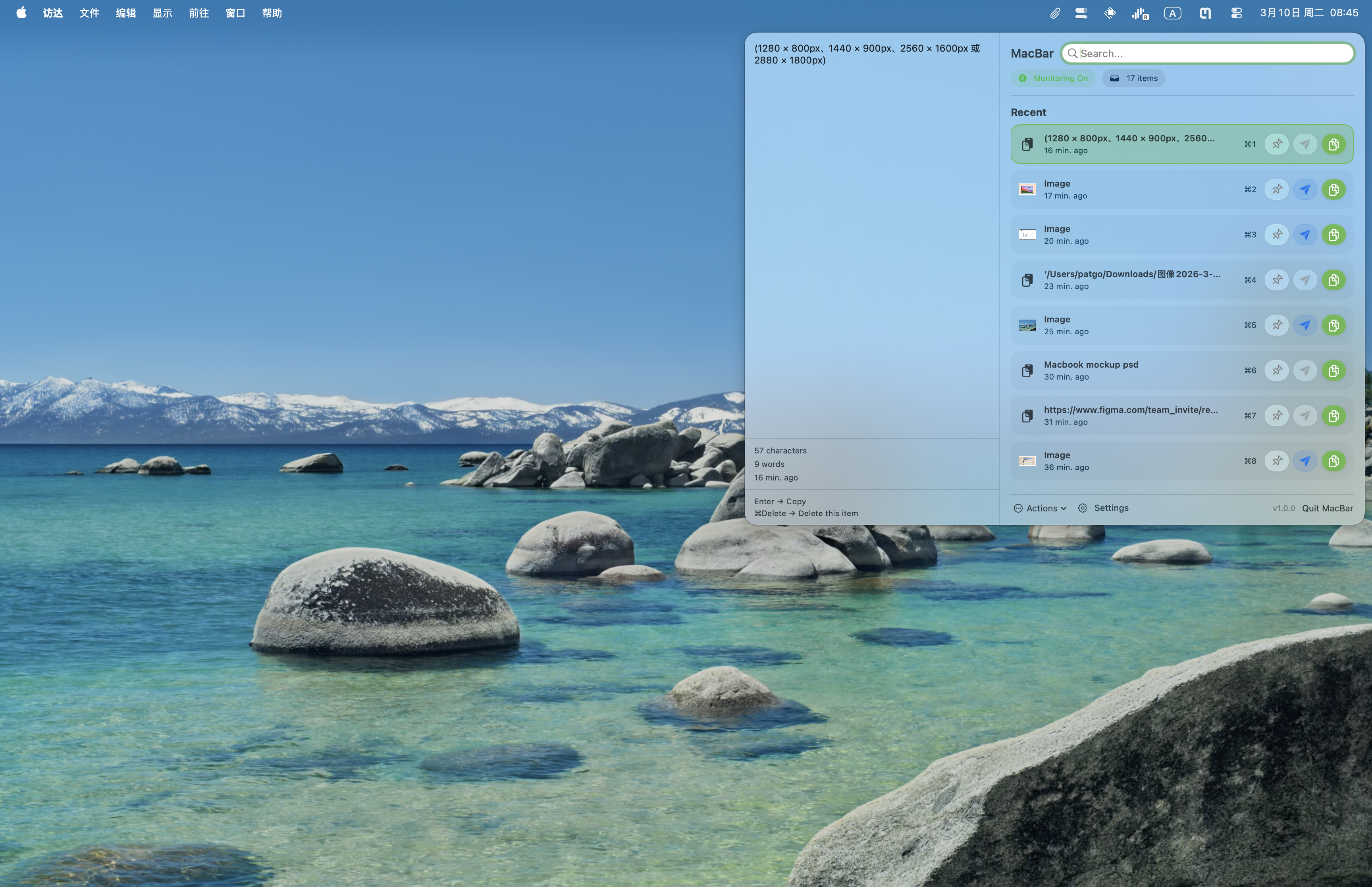
MacBar running on a Mac desktop with clipboard history, preview, and search visible
Built for real paste destinations

Paste screenshots into apps as images, or copy them back out as files when Finder is the target.

Direct answer

What is MacBar?

MacBar is a local-first clipboard manager for macOS. It stores clipboard history for text, screenshots, copied image files, and Finder files, runs OCR on-device with Apple Vision, and lets you search, preview, pin, copy, and AirDrop clipboard items from the menu bar.

Best for screenshot-heavy clipboard workflows
Runs locally on your Mac
Searches text, OCR, filenames, and paths
Made for image-heavy clipboard work

Built for the copy-paste loop you actually repeat all day

Fully local Clipboard history stays on your Mac with no network dependency.
No telemetry No analytics, no crash SDK, no third-party dependencies.
Keyboard-first Open fast, search fast, copy fast, and get out of the way.
No account required Open the panel, search, copy, and keep moving without signing in or setting up a workspace.

Product evidence

Not just a promise. The interface is built around how clipboard work actually happens.

MacBar does not hide its strongest ideas in settings. OCR, image/file reuse, and onboarding are visible in the first few screens because those are the moments that decide whether a clipboard tool is genuinely useful.

Desktop context

MacBar stays close to the work already on your screen instead of pulling you into a separate app.

The panel opens over your current desktop, so search, preview, and reuse happen in one quick stop before you paste back into the app you were already using.

MacBar shown in context on a Mac desktop

OCR in context

Screenshots and copied image files become searchable, readable clipboard entries.

OCR is not a side feature. It is part of the main clipboard surface, so text inside images becomes something you can immediately search and reuse.

MacBar shown on a MacBook with OCR-focused marketing composition

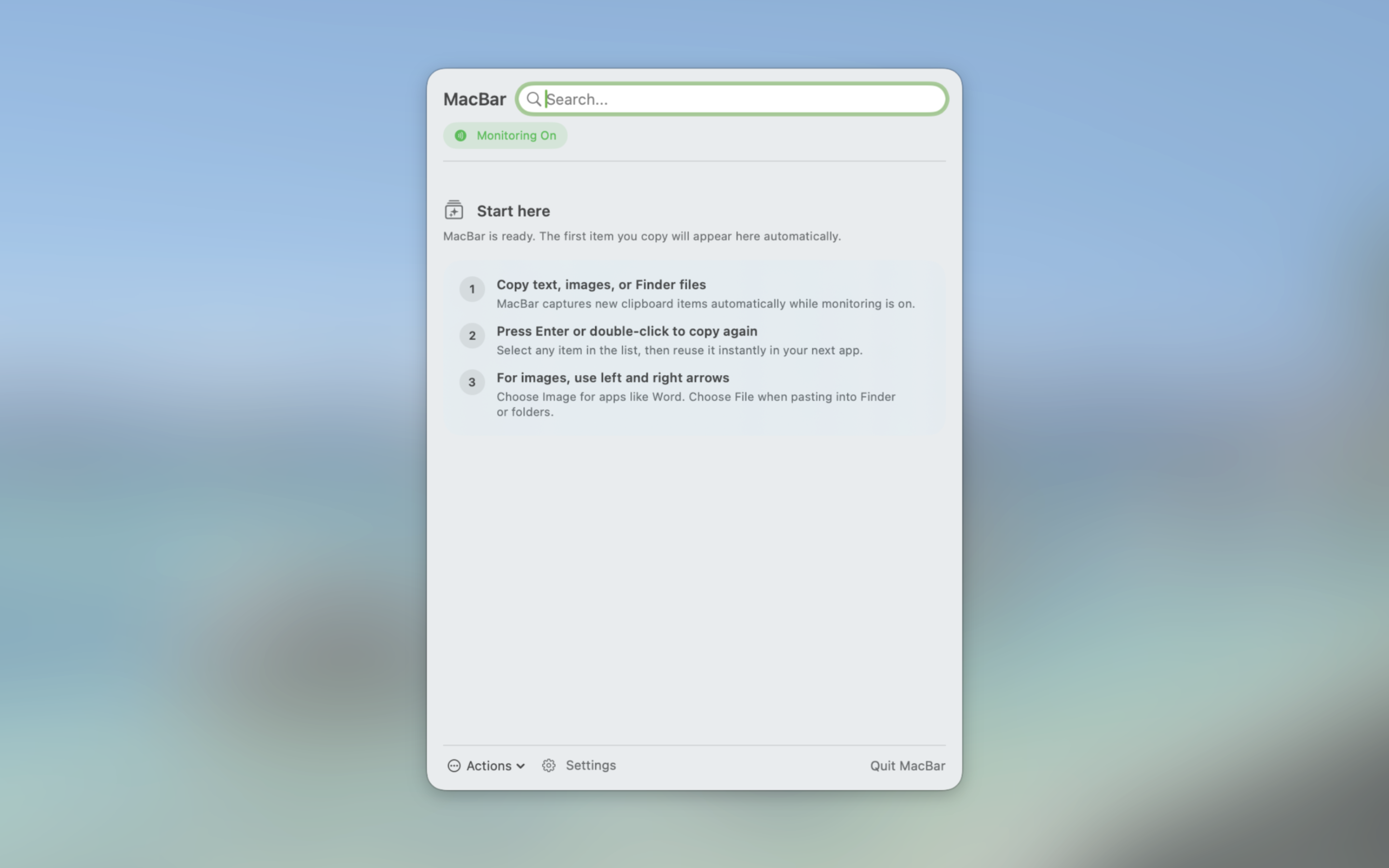
Starts simple

The empty state teaches the workflow instead of leaving first-time users guessing.

MacBar now introduces the first steps directly in the panel, so people understand what to copy, how to reopen items, and how image copy modes behave before the history gets crowded.

MacBar onboarding empty state screenshot

Why MacBar

It treats screenshots like information, not dead pixels.

OCR that matters

Pull text out of screenshots and copied image files without leaving your workflow.

Error dialogs, annotated mockups, chat screenshots, terminal captures, or image files copied from Finder. Select the image, let Vision extract the text locally, then search or copy it back.

On-device via Apple Vision OCR text indexed for search One-click OCR copy

Search everything

Text, OCR, filenames, and full file paths in one search bar.

You do not need to remember where something came from. If it was copied, MacBar can help you find it.

Files and sharing

Finder files and copied images stay actionable with preview, Finder, paste, or AirDrop.

Image files copied from Finder preview like screenshots, while files keep their full paths. Reveal them in Finder, paste them again, or send files and images straight from the panel with AirDrop.

Selection that follows

Hover the row you want and it becomes the active item for preview, copy, and shortcuts.

Mouse browsing no longer fights the current selection. Skim a dense clipboard history, stop on the right row, then act immediately.

Pinned memory

Keep frequently reused snippets fixed at the top.

Pin prompts, links, shell commands, and boilerplate text so they do not disappear in the scroll.

Stays fast

Disk-backed images, queued OCR, and cached search metadata keep larger histories lighter.

The panel does less repeated work on every open and every keystroke, so image-heavy histories stay usable instead of turning sluggish.
Daily flow

Three beats. Copy, surface, paste.

01

Copy anything

Text, screenshots, copied image files, and Finder files are captured quietly in the background.

02

Call MacBar

Hit ⇧⌘M, type a few letters, or use the arrow keys and shortcuts.

03

Paste and move on

Copy the item, let the panel get out of the way, and continue where you already were.

Where it helps most

Especially useful when your clipboard contains screenshots with real work inside them.

MacBar was built around practical screenshot-heavy scenarios where other clipboard managers usually stop at image previews.

Error messages in modal dialogs Numbers and annotations from design specs Code snippets shared as images Table fragments from docs or slides

Private by default

Your clipboard should not need a server.

MacBar keeps its scope intentionally narrow. It does not sync to the cloud, does not phone home, and does not depend on third-party libraries to handle your clipboard history.

Storage Local UserDefaults only
OCR engine Apple Vision on-device
Network usage None during normal app use
Clipboard control Monitoring can be paused any time

Availability

Available on the Mac App Store.

MacBar is distributed through the Mac App Store. Install it there, launch it once, and leave it in your menu bar for daily clipboard work.

1 Open the Mac App Store and search for MacBar
2 Install the app and launch it once
3 Keep it in the menu bar and start copying text, images, and files

Beta access

Want to try upcoming builds before release?

Join the MacBar TestFlight to try in-progress builds and share feedback before changes reach the public App Store version.

Join TestFlight

FAQ

A few things people usually want to know first.

Does MacBar upload my clipboard to the cloud?

No. Clipboard history stays local and OCR runs on-device. MacBar does not upload clipboard data and does not need a network connection during normal use.

What can it capture?

Text, images, and Finder file copies. Search covers text content, OCR results from screenshots and copied image files, filenames, and full file paths.

Where can I get MacBar?

MacBar is available through the Mac App Store. Check the current App Store listing for availability in your region.

Who is MacBar best for?

MacBar is especially useful for people who constantly copy screenshots, copied image files, text snippets, and Finder files, then need to search or reuse them quickly.

How is MacBar different from a basic clipboard manager?

MacBar is built around screenshot-heavy workflows. It can run local OCR on screenshots and copied image files, index OCR text for search, keep file paths searchable, and make files and images directly actionable from the panel.

Representative perspectives

How MacBar fits into different screenshot-heavy workflows.

These are sample user perspectives based on common use cases, not verified customer testimonials.

Sample perspective

Frontend engineer

“The best part is not typing browser errors from screenshots by hand anymore.”

Works across terminal captures, bug reports, chat screenshots, and copied code fragments.

Sample perspective

Product designer

“Design annotations stop being trapped in images once OCR makes them searchable.”

Useful for spec screenshots, redline numbers, and quick visual references copied out of Figma or chat.

Sample perspective

Founder or operator

“I use it like a scratch buffer for links, files, meeting snapshots, and prompts all day.”

The value is speed: open, search, copy, and get back to the app you were already using.